

One of the consequences of political instability in France has that it revealed the fracturing of Western alliances as President Trump and President Macron swapped insults and blame for the riots gripping France. The consensus seems to be that the riots, which have spread to many other European countries, will continue and escalate.
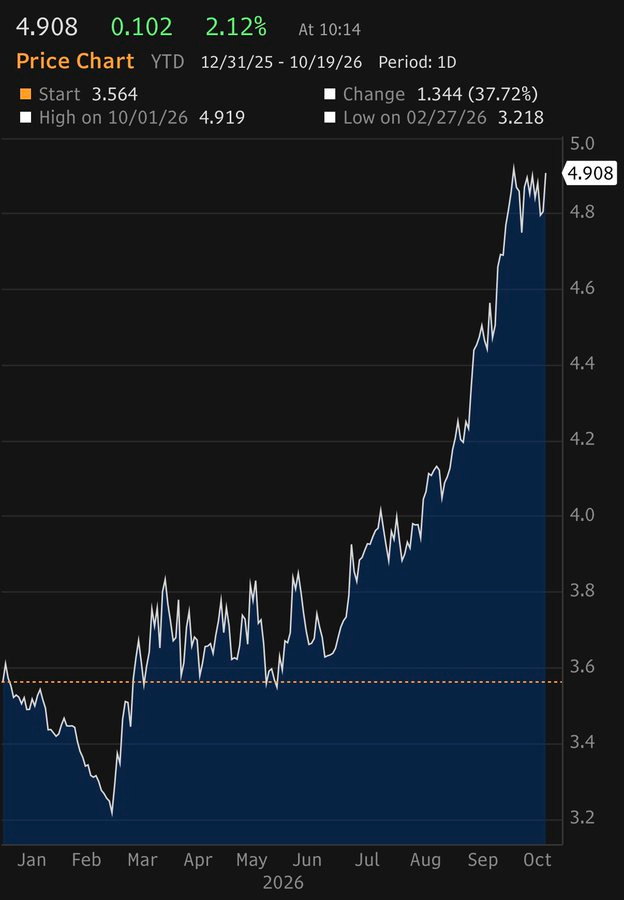
In fact, it seems that the French government is caught in something of a perfect storm surging both from the bottom-up and from the top-down: while the struggling French people are increasingly restless and ready to pour into the streets and protest, global capital markets have been exerting pressure on France’s dismal finances. Just in the past ten months, the interest rate on French government bonds soared by nearly 40%.
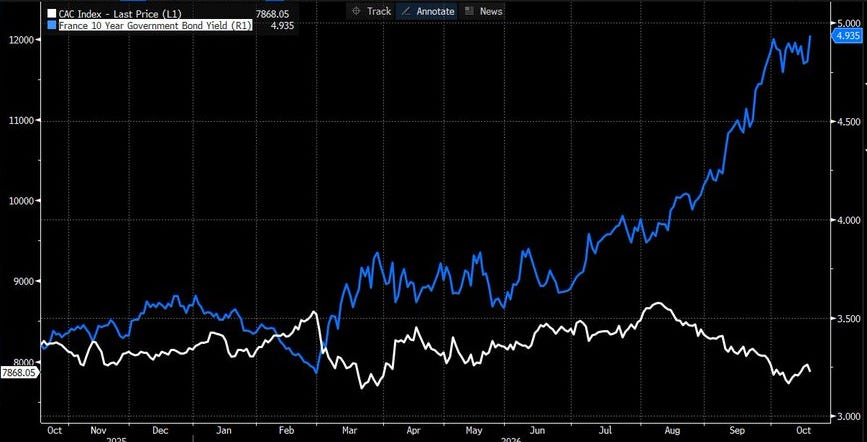
Incidentally, that chart became obsolete in the space of about one day. By now, interest rate on the 10-year French government bonds rose to 4.935%. But unlike in the United States, French stocks went nowhere and may have entered into a bear market. With both bond prices and stock prices collapsing, the value of collateral in the banking system is melting away in a self-stoking cycle and no end in sight.
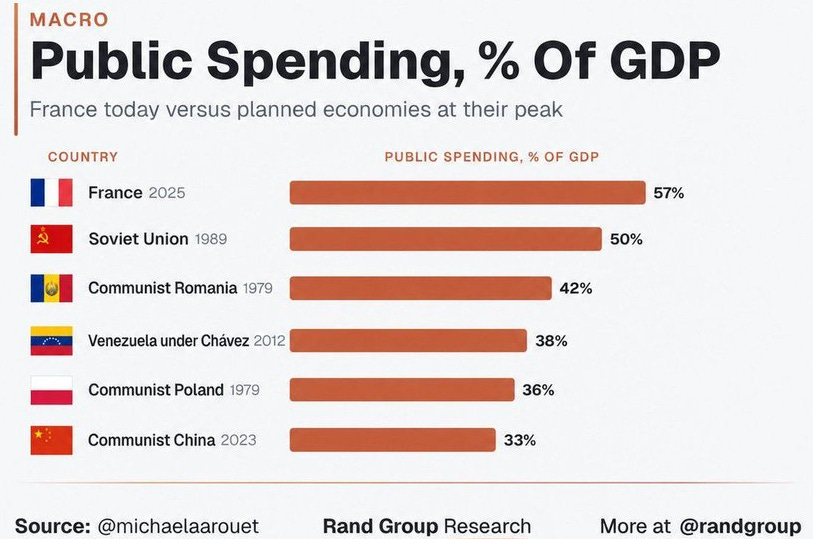
In France, government spending represents nearly 57% of the GDP. One Michael Aarouet put together a handy comparison of French state’s share of the GDP with that of other capitalist liberal democracies:
The system is drowning in debt…
At €3.6 trillion, France’s public debt is just short of 120% of the GDP. By now, all these trillions in debt and also the GDP percentages above, mostly just elicit yawns because it’s all become so new normal. But if we calculate public debt on a per capita basis, things look a bit more serious: €3.6 trillion represents about €52,000 per man, woman and child living in France today. With the government running annual fiscal deficits of up to 5.8%, this debt load is 100% certain to continue inflating, suffocating French economy and further stoking social pressures.
No, it’s not about “socialism.” It’s deeper than that!
And for anyone about to yell, “socialism” about now, we have to understand that the problem does not originate with profligate “socialist” governments, nor can we solve it by voting in capitalist, conservative, pro-small government officials. The problem is entirely systemic and the system is demonstrably immune to the intended or desired policies of elected officials and even more so to the will of their voters.
Even if they passionately advocated balancing budgets, paying down debts and reducing government footprint in the economy, once they’re in office, public officials will continue down the same path of deficit spending. I elaborated this in August in the article titled, “Why governments can NEVER give up deficit spending.” There will be no voting our way out of those problems. The article is linked belw:

The geostrategic consequences
There can be little doubt that the festering, escalating financial crisis will have very substantial geostrategic consequences. At some point, the Unity of the combined West, centered on our “shared values” will begin to disintegrate and individual nations will move to mitigate the crisis at home, regardless of how this could impact their allies by shared values.
In fact, we are well past that point; the perfect example is President Trump’s recent “Diesel Deal” with Russia’s President Putin. That deal is also an example of the United States’ capability to manage the crisis and and engineer a soft(er) landing for itself by managing its fiscal crisis. Other examples include the American leverage over other nations in the Western hemisphere, which are being turned, one by one, into colonial outposts of Wall Street banks.
Regardless of the ethical ramifications of those arrangements, it is securing new collateral as well as future demand for US dollars for the bankers who issue it. That will mitigate US financial crisis, at least marginally. Manwhile, the Europeans are well and thoroughly stuck. In only a few years, they’ve managed to largely destroy, not only their industrial base and energy production, but also their relationships with Russia, China, Iran, Arab nations, much of the Global South, and the United States.
The only front where they still have considerable leverage is against their own people where regulation, censorship and repression are growing worse with each passing day, so we get demonstrations and riots. At the same time, they are trying hard to convince the white, Christian part of that population, that doing their “duty” and sacrificing themselves and their children in a war against Russia is right and necessary in order for us to protect our countries and our way of life.
Desperate for war
By now, however, a large segment of that same population no longer care to preserve that way of life and, the crisis is only going from bad to worse, which is why most observers expect that things will continue down that same path. Inability and unwillingness to solve very much of anything leaves war as the only pressure-release valve available to the authorities. Even on that front, Europe is finding itself isolated.
Our designated enemy, Russia, understands the score well enough and is happy to play ball with the United States in order to try to forge a more cooperative, more constructive relationship going forward. Among the American officials, it seems that more and more of them are prepared to kick the Russophobia and get on with business, as we witnessed with the Diesel Deal, as well as last week’s UN Security Council meeting. During the course of UNSC proceedings, the American conciliatory statements vis-a-vis Russia stood in sharp contrast with the rabid, hostile position of European representatives.
The fate of Russia’s frozen assets
This brings us back to the fate of Russia’s frozen assets in Western jurisdictions. The amount in question is estimated at $300 to $335 billion. Most of these assets by far are held in Europe: the largest portion is managed by Belgium-based Euroclear central securities depository, which holds around $190 to $208 billion.
France holds up to $71 billion in Russian Central Bank assets, but the suspicion is that Macron government already helped themselves to much of that money. According to more recent figures, only about $25.6 billion of the Russian money remains in French custody. The UK holds about $37 billion of Russian assets. At the same time, the US portion is estimated at only $5 billion to $8 billion, primarily in debt securities and cash.
During his recent appearance at the Warsaw Security Forum, Poland’s British Agent Foreign Minister Radoslaw Sikorski stated that those assets would be returned to Russia, “over our dead bodies.” Indeed, Russia is unlikely to see the return of those assets any time soon, but both the Kremlin and their American counterparts might have their own reasons to transfer the totality of those assets to US custody.
Last August, in the immediate aftermath of the Alaska summit between Presidents Trump and Putin, I wrote as follows:
I suspect that one of the outcomes of Russia-US cooperation - this we will find out in due course - will resolve the fate of the Russian frozen assets held by Western countries. … Trump will likely be keenly interested to have Russia invest that money in the US. For their part, the Russians have every reason in the world to accommodate Trump and such an investment deal would certainly go a long way to advancing the two powers’ cooperation. …
For the collateral starved British financial system, this could prove catastrophic. The same is true for Europe: Emmanuel Macron‘s dream of using $260 billion in frozen Russian assets as collateral for reconstruction investments was also meant to underpin a large-scale credit impulse in Europe. The reconstruction [of Ukraine] was meant to be financed by European banks and the contracts awarded to European corporations. Unfortunately, none of that will be possible without strong backing by the United States.”
If anything about Donald Trump is predictable, it is that he’ll want those assets in the US … For the same low price he’ll get to deliver another humiliating kick to the duplicitous, warmongering Europeans. I simply don’t see him resisting that temptation and one day soon, the news will report that Trump has ordered that the Russian assets held in Europe be transferred to US custody. The Eurotards will have no recourse but to comply.
Vladimir Putin’s special envoy: it will be glorious!
Just today, on the first day of the XIX Verona Eurasian Economic Forum in Istanbul, Mr. Kirill Dmitriev, the CEO of Russian Direct Investment Fund and Vladimir Putin’s Special Envoy for investment and economic cooperation spoke about the economic cooperation between Russia and the United States being the foundation of the dialogue and development of the relationship between the two powers.
He also spoke that this cooperation will exert further pressure on European governments: when they see Russia and the United States engage in a mutually beneficial, constructive cooperation, the Europeans will not want to be left behind. In time, they will have to sober up and come to the negotiating table. The ever optimistic Mr. Dmitriev chose the term, “glorious” to describe the ultimate results of that cooperation. Mr. Dmitriev’s remarks start at the 1:38-min. mark in the video linked below:
Well, getting the Europeans to sober up will be a different challenge, and removing the punchbowl might require the transfer of Russia’s frozen asset to US custody. If (when) that happens, the EU will sustain a crippling financial blow. People like Mr. Sikorski might have little recourse but to offer “our dead bodies.”
Mired in political paralysis, facing unsolvable economic crises and squeezed between the Russia it alienated and a hostile United States, Europe will have to make peace with the fact that after many centuries, the world is no longer Euro-centric and that they’ll have to learn to treat other players on the global scene as their equals.
Hopefully, after experiencing some withdrawal symptoms, a fully sober, constructive and cooperative Europe without a superiority complex, might emerge. The sooner it does, the better it will be for all involved. Who knows, maybe it really will be glorious, if not for Mr. Sikorski, then certainly for most of the rest of us.
Alex Krainer – @NakedHedgie is the creator of I-System Trend Following and publisher of daily TrendCompass investor reports which cover over 200 financial and commodities markets. One-month test drive is always free of charge, no jumping through hoops to cancel. To start your trial subscription, drop us an email at TrendCompass@ISystem-TF.com, or:
NEW: Check out our daily TrendCompass on Substack, covering 19 key global markets, incl. gold and bitcoin at under $1/day
For US investors, we propose a trend-driven inflation/recession resilient portfolio covering a basket of 30+ financial and commodities markets. Further information is at this link.
It would be a big mistake for russia to trust anything agreed to by the US...
"Not agreement capable"
The Iranians are echoing this daily.
Thanks so much Alex. Great info. Long-live the US-Russian alliance. Let's build that Bering Strait tunnel!