

This is part 1 of a 3-part report on the subject which, to my mind, could be the most important subject matter for us to learn about. The better we can understand it, the brighter the future we can leave behind for future generations, and the less likely that we’ll fall into old, false dichotomies calculated for the divide-and-rule effect. The YT video below unites parts 1 and 2. Part 3 will be published soon.
For all the “AI slop” experts out there, the video is 0% AI-generated (only the thumbnail was done with AI).
Over the recent years, I’ve repeatedly referred to the continuing global geopolitical upheaval as a conflict between two systems of governance. In fact, many Western leaders refer to it in those terms, usually characterizing the conflict as a clash between open societies and closed societies, or between democracies and autocracies. However, these are self-serving misrepresentations.
One conflict, many battlefronts
In reality, the conflict is between the Western colonialist system and anyone who rejects its demand for subjugation to the imperial hegemon. If we wish to understand the current events in the world and how they fit together, it is extremely important that we correctly identify the fault lines in this conflict, and the true nature of the two opposed systems of governance.
Once we gain that clarity, it becomes much easier to see that the war in Ukraine, war against Iran, genocide of the Palestinian people, the buildup to the war on China, the uncontrolled migrations and many other social, political and economic crises are all merely different battlefields of the same great conflict.
In his letter to Ephesians, Paul warned that we wrestle not against flesh and blood, but against principalities, against powers, against the rulers of the darkness of this world, and against spiritual wickedness in high places. We can also say that we struggle against a system that wields those powers and supports those principalities, their darkness and their spiritual wickedness.
The conflict’s geopolitical manifestations are today relatively easier to discern, but its roots lay in the two systems’ economic foundations, which determine the nature and the conduct of the opposed systems.
Understanding the difference between the two economic systems is so important that our ruling establishments went out of their way to scrub this knowledge from the economics curriculum so thoroughly, that it was almost completely lost. The very fact that I was able to put this report together is something of a gift and before signing off, I will spend a moment to address the question of how we know what we know, and who deserves credit, or even a monument for rescuing this knowledge from oblivion.
Stand and deliver: free trade or your life!
So, what are these two opposed systems of economic governance? One is the British system of free trade. The other is the national system of political economy. It is often referred to as the American system because it was pioneered by American leaders like Alexander Hamilton, Henry Clay, Abraham Lincoln, and Lincoln’s chief economic advisor Henry C. Carey.
In a nutshell, the national system seeks to create protective barriers to foreign trade in order to give the domestic manufacturing a fighting chance against foreign competition. It also accumulates capital at home, investing it into manufacturing, infrastructure, education, research and development, innovation, culture and other uses that raise the society’s living standards.
By contrast, the British system of free trade extracts wealth and concentrates it: it seeks to remove all barriers to worldwide free flow of capital, always in pursuit of highest possible returns. With free trade, nations are obliged to compete for investment capital by systematically depressing wages, job security, pensions, health care services and education.
Other costs which cut into the returns on capital are infrastructure development, social spending programs and protection of the environment. Therefore, competing globally for investment capital entails progressive slashing of all these cost items, down to the bare bones. In that sense, British free trade system amounts to a competitive race to the bottom.
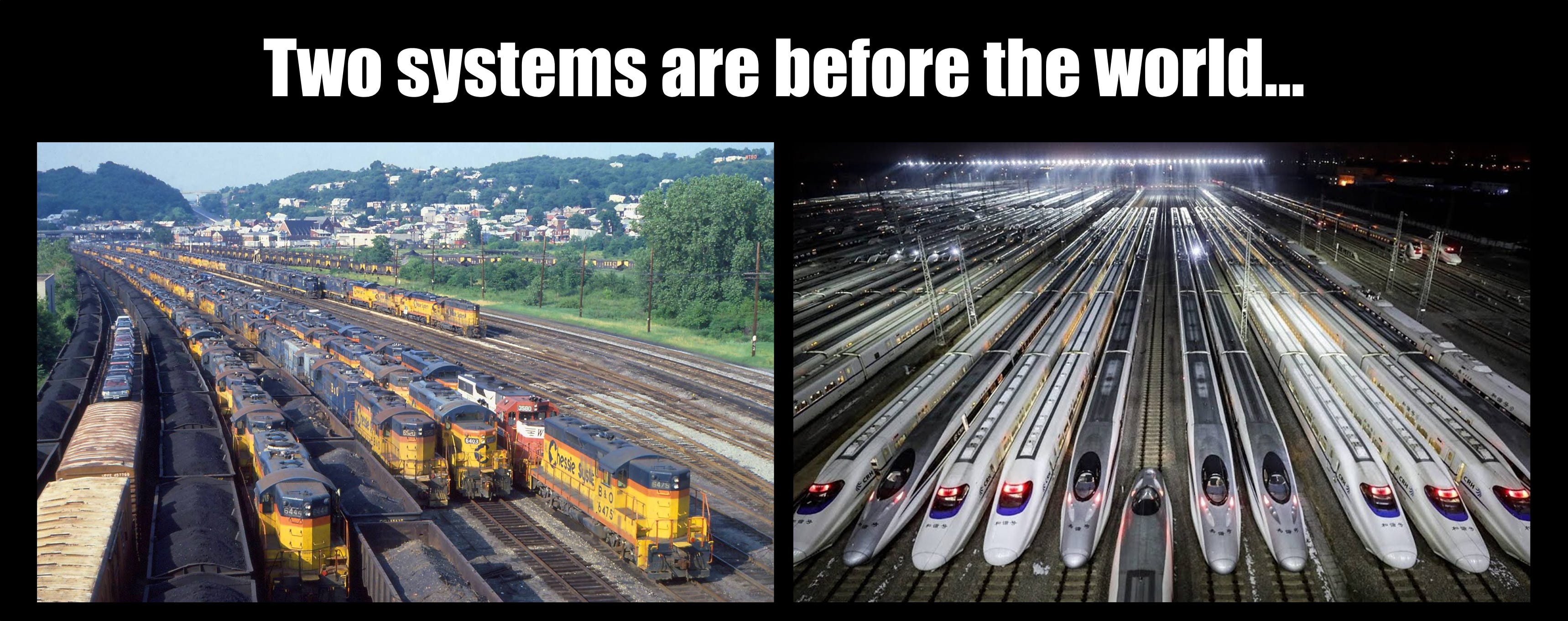
In his 1851 book titled, “The Harmony of Interests,” Abraham Lincoln’s economic advisor Henry Carey contrasted the two systems, opening with the words, “Two systems are before the world…”
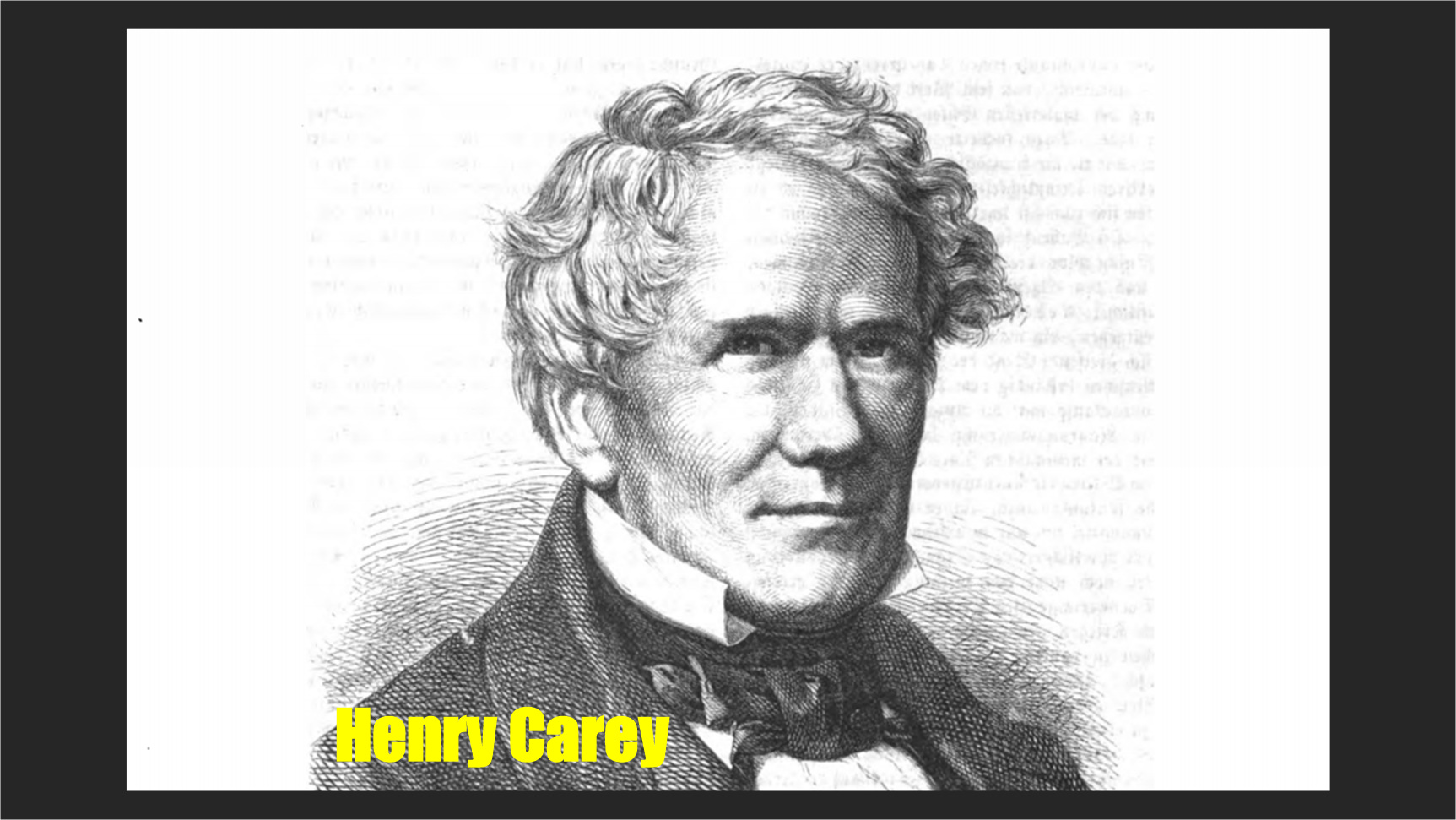
Carey’s prose is rather long, but it could be summarized along seven key dimensions:
1. Trade vs. production: one system directs labor and capital toward trade and speculation. This tends to depress wages and erode prosperity. The other system fosters production of goods, services and infrastructure. It leads to higher wages and rising standards of living.
2. Raw materials vs. finished goods: one system favors mass production of raw materials and cash crops for wholesale trade. It systematically impoverishes farmers and reduces their employment. The other system favors production of more refined, high quality products, enriching their producers.
3. Exporting produce vs. enjoying it at home: one system sends mass produced bulk abroad, sometimes even causing famines in the producing economy. The other system organizes labor to satisfy domestic demand and produce an abundance of diverse, high quality products at home.
4. Concentration vs. dispersion of wealth: one system concentrates wealth and power in few hands, in great commercial cities while depleting and impoverishing the rest of the nation; the other system enriches those engaged in production and disperses wealth more evenly across society.
5. Military spending vs. moral and intellectual growth: one system compels the productive sector to fund fleets and armies; the other directs the same means for moral and intellectual growth of the people in their own nations.
6. Stable communities vs. population replacement: one system requires a large, low-skilled labor force that accepts work with low wages. It predictably resorts to mass influx of migrants. The other system raises the standards of living, prosperity and security of the native labor force.
7. Universal war vs. universal peace: one system gives rise to universal forever wars; the other strives to preserve peace.
Let’s condense these seven points further: one system favors production of raw commodities in bulk. It lowers living standards, concentrates wealth in few hands, impoverishes the workforce and favors population replacement, militarization and forever wars. This is the British system of free trade.
The other system favors production of diverse, quality products at home, enriches their producers, raises living standards, disperses wealth, fosters stable communities and favors stability and peace. This is the national system of political economy, or the American system. Its aspiration is sovereignty and independence. Free trade system’s aspiration is globalization and unipolar hegemony.
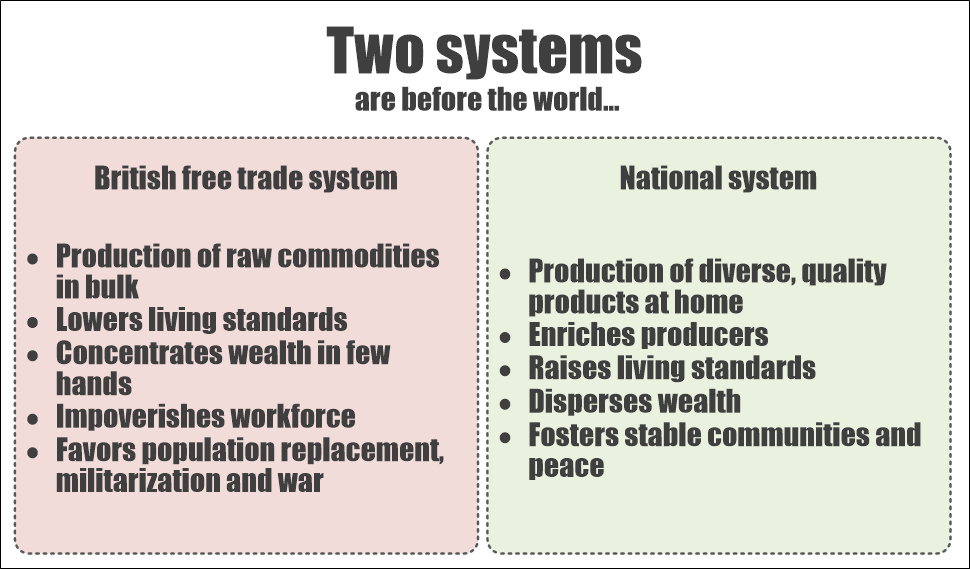
The contrast between the two systems could not be any starker, and the record entirely validates the way Henry Carey characterized them, as we’ll see from actual historical examples where one system or the other was implemented, and from the ways they changed the societies in question.
First, we’ll look at the effects of the British free trade system through the example of its mothership, the British Empire. We won’t need many other examples, since the whole developed world gradually adopted the free trade system over the last five decades. Its effects are discernible everywhere around us today, including economic decline, eroding standards of living, disappearance of the middle classes, uncontrolled migrations, as well as perpetual wars. The free trade system always produces these same symptoms, just as Henry Carey described them.
We’ll also examine the effects of the national system through examples of the post-revolutionary United States, late 19th century Germany, and post-war Italy. In a separate report, we’ll add the fourth and perhaps most spectacular case, which is modern China.
How free trade destroyed the British Empire
Free trade system is the economic and intellectual heritage of European colonial empires. It was refined and perfected by the stewards of the British Empire. After the defeat of Napoleon Bonaparte at Waterloo in 1815, Britain eliminated its greatest European rival and was now in position to consolidate its power globally and lay the groundwork for a unipolar global order under her own dominance.
Only one year after Waterloo, on 22nd June 1816, British parliament enacted a law declaring gold to be the sole measure of value in the Empire. The ensuing scramble for gold largely shaped British foreign policy over the following eight decades. Its imperative was to ensure that the newly mined gold from Australia, California and South Africa flowed into the vaults of the Bank of England while denying the same, as much as possible, to all other nations, including the United States.
That required establishing naval supremacy across the world’s oceans. Britain’s dominance in shipping, maritime insurance and control over key ports, trade routes and maritime chokepoints enabled her to limit other powers’ access to global markets. British ships carried gold and silver, as well as steel, coal and other commodities from her colonies back to England while the products of English industries sailed to foreign markets around the world.
In the process, Britain accumulated the world’s largest hoard of monetary gold. Indeed, the stunning success of this colossal-scale looting operation also shaped Britain’s internal economic and social policies. The program was working or, at least it was working for the British ruling classes, so it had to be enshrined, protected and defended.
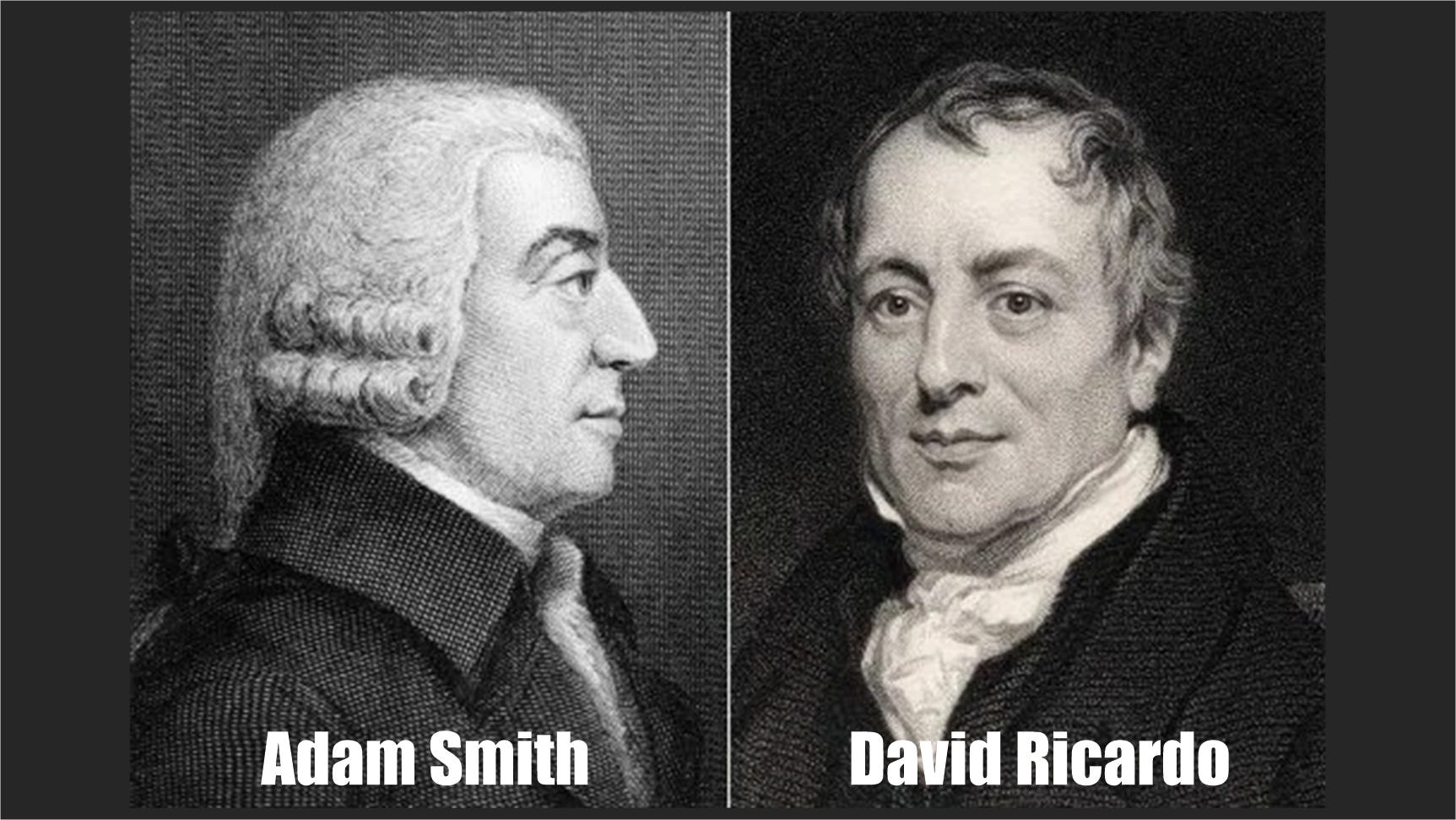
In 1820, under the influence of a powerful group of London merchants and bankers concentrated around the Bank of England, British parliament passed a Statement of Principle in support of so-called “absolute free trade.” The idea was formulated a few decades earlier by the Scottish economist Adam Smith and a banking oligarch, David Ricardo.
Under this system, Britain’s bulging accumulation of capital would not be squandered on domestic economic development or improvements for the ordinary British people. Instead, it would be invested into enhancing the original looting operation by expanding Britain’s colonial conquests and global free trade.
In 1843, some 23 years after absolute free trade was enshrined as the empire’s official policy, its main beneficiaries founded a weekly propaganda journal, The Economist, whose explicit purpose was to promote and reinforce the intellectual foundations supporting the free trade system.
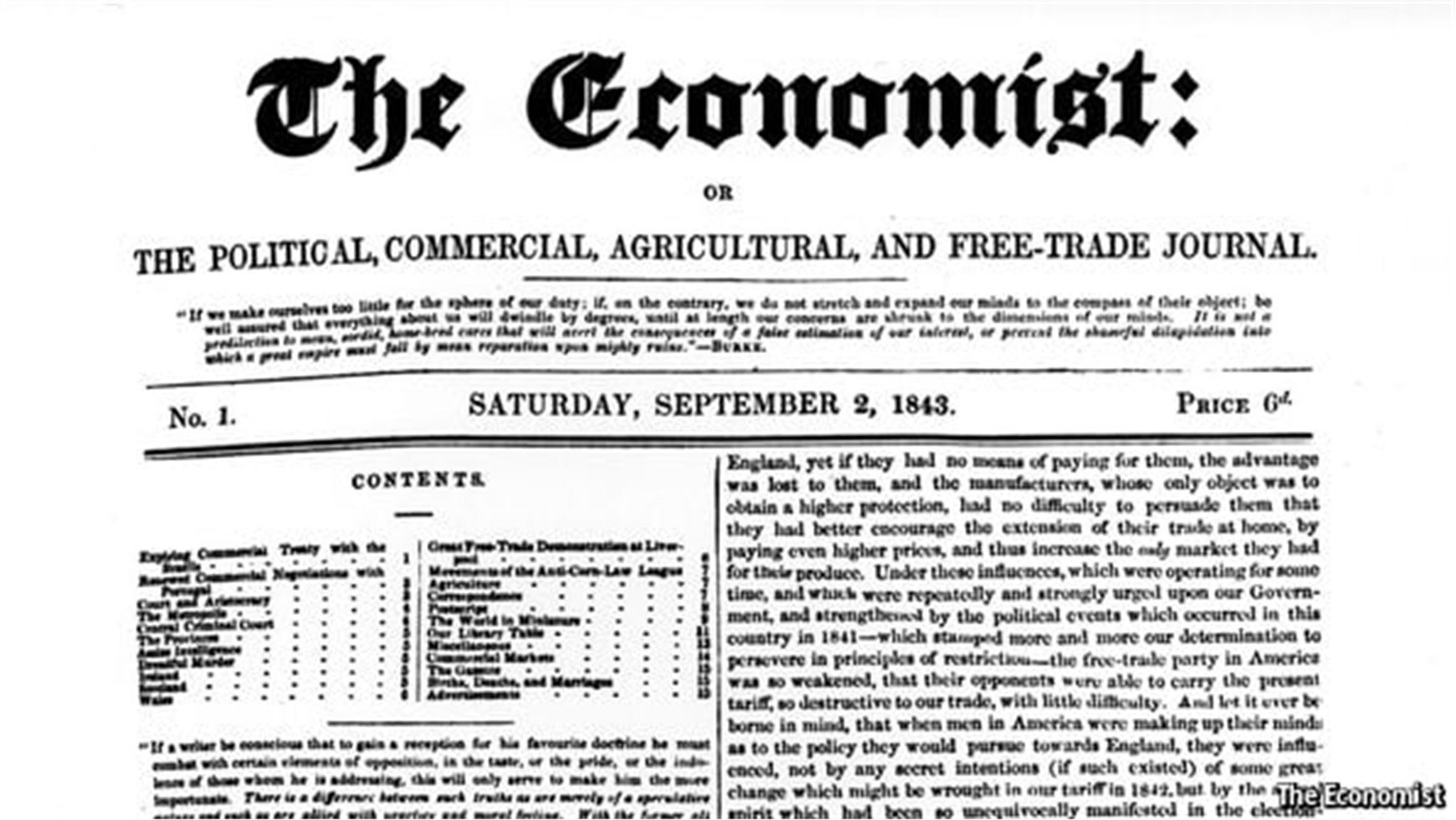
In large part, this was necessary to prepare the grounds for an assault on British workers and their communities. Namely, depressing the cost of labor was part and parcel of the free trade system, so any protections that British workers and farmers enjoyed, had to be eliminated. Britain’s domestic markets would have to be opened wide to cheap imports from around the world, which crushed local producers and devastated the domestic economy.
Crushing British farmers
For example, in 1846, the Parliament repealed the so-called “Corn Laws,” which had protected British farmers from foreign imports. After their repeal, African or Hindu farmers, working for slave-level wages, could compete against British and Irish farmers for the market of British “consumers.”
The result was that the prices of produce, wage levels and living standards in Britain began to collapse and the society started to rot from within. This is particularly relevant today as President Trump just announced a “deal” to allow imports of up to 300,000 tons of ground beef at 25% below US market prices. The deal will deal quite a blow to the American farmers, as cheap imports did to the British and Irish farmers after 1846.
A contemporary writer, one Joseph Kay, observed these developments and in the early 1850s and described Britain as the place,
“Where the aristocracy is richer and more powerful than [in] any other country in the world, the poor are more oppressed, more pauperized, more numerous in comparison to the other classes, more irreligious and very much worse educated than the poor of any other European nation…”
Of course, the “free trade” system did have its winners. They were the ship owners, merchants, large industrialists and bankers who reaped enormous profits from all the global trade. This colonialist “aristocracy” didn’t question the “success” of their system. They pursued it further and defended it with a growing zeal and avarice.
Industrial-scale looting
They subjected their colonial possessions in India, China and Africa to increasingly ruthless looting, and the wealth they extracted flowed in prodigious amounts to fund new looting operations in places like Argentina, Brazil and the United States, if only in a more refined form. The old systems of bondage gave way to new systems. Instead of military conquest and chains, the new and improved system was forged with instruments of debt and reinforced with some gunboat diplomacy.
For their new colonial possessions, Britain’s financiers issued credit to develop mines and plantations, and to build railroads and ports needed to move their products and load them onto ships. In the process, they saddled the local economies with massive amounts of debt. Servicing those debts would keep the colonies impoverished and chronically underdeveloped.
For example, during the 1880’s, Argentina’s new ports and railroads enabled her to move large quantities of beef and wheat for export, but at the same time her external debts to London bankers increased by 700%. This was the new & improved, “imperialism on the cheap,” as one columnist tagged it at the time.
The need for “security”
Of course, the stunning “success” of Britain’s colonial business model didn’t go unnoticed by her potential rivals, so to protect this looting operation from any aspiring competitors or pirates, more and more capital had to be invested in its security. In addition to building a large fleet of warships, the Empire evolved an elaborate and sophisticated security state, bringing together an extensive, revolving door network of intelligence agents, diplomats, heads of strategic industrial companies, leading merchants and City of London bankers.
In fact, British security state has evolved from those foundations to the present time. One example was Sir Charles Jocelyn Hambro, a prominent banker who sat as a director of the Bank of England from 1928 until his death in 1963. During WWII, he was the Chief Executive of the British secret intelligence agency, the Special Operations Executive (SOE) at the Ministry of Economic Warfare.
In the immediate aftermath of World War 2, Hambro and the SOE played the key role in developing a similar security state architecture in the U.S. including the formation of the Central Intelligence Agency and training up its leading talent - such nice people as William Casey, Charles Kindelberger, Walt Rostow and Robert Roosa. Incidentally, it was William Casey who said that, “We’ll know our disinformation program is complete when everything the American public believes is false.”
1857 bank panic and the 23-year Great Depression
At the façade, the British system seemed unassailable, but its internal rot, radical polarization of wealth and increasing allocation of that wealth to speculative ends and warfare, ultimately led to its collapse. As I mentioned above, London’s gold hoard was largely invested toward enhancing its colossal looting operation, into new ventures abroad.
As a result, the gold stored in London vaults wasn’t nearly sufficient to meet the ballooning claims against it. In 1857 a banking panic erupted, triggering a run on Bank of England’s gold reserves, which in turn collapsed bank credit across the country and precipitated an economic depression. As devastating as that was, it was only the beginning of Britain’s troubles.
The policies pursued by the City of London bankers weren’t concerned with the economic recovery for the nation. Instead, they obsessed about reversing the outflow of gold and returning the bullion into the vaults of London banks and the Bank of England. To achieve that, the bankers started raising interest rates.
The idea was to incentivize investors around the world to bring their gold back to England and exchange it for the interest-bearing financial instruments. In that sense, the policy was successful, but it came with a huge cost for the British economy and for the ordinary Britons.
High interest rates caused a wave of business bankruptcies and foreclosures. The financial bubble that emerged from speculation on railways construction in North and South Americas suddenly collapsed, and by 1873 Britain fell into The Great Depression which would last for 23 years, until 1896.
During that time, even though the British Empire was globally at the zenith of its power, the price levels in free trade Britain collapsed by nearly 50%, ruining farmers, destroying businesses at a mass scale, causing widespread and seemingly permanent unemployment and subjecting the British people to crushing poverty, homelessness and hopelessness. It was the stuff of Charles Dickens’ heart wrenching novels.
Free trade ruins every nation it touches
Sadly, much of this may ring familiar today because the free trade system produces the same symptoms of social decay wherever it is implemented. Again, those symptoms include economic stagnation, erosion of living standards, disappearance of the middle classes, impoverishment of workers and farmers, deterioration of the infrastructure, oppression of the people, population replacement and forever wars.
However, all these symptoms of economic and social decay are very much curable and the cure is perfectly well known: it is the national system of political economy, or the American system. Its earliest explicit implementation, at least in the modern times, goes back to Revolutionary America in the late 1700s.
To be continued…
In part 2 of this report, we’ll explore the experience and the results of implementing the national system in the United States during the 1800s; in Germany between 1873 and 1913; and in Italy after World War 2. As we’ll see, the outcomes were spectacular and radically different from those of the ruinous British free trade.
Alex Krainer – @NakedHedgie is the creator of I-System Trend Following and publisher of daily TrendCompass investor reports which cover over 200 financial and commodities markets. One-month test drive is always free of charge, no jumping through hoops to cancel. To start your trial subscription, drop us an email at TrendCompass@ISystem-TF.com, or:
NEW: Check out our daily TrendCompass on Substack, covering 19 key global markets, incl. gold and bitcoin at under $1/day
For US investors, we propose a trend-driven inflation/recession resilient portfolio covering a basket of 30+ financial and commodities markets. Further information is at this link.
This is true and sounds good but sadly I don't see the American system of economy pushed anywhere right now in seriousness, no where where they're winning. Only a few allusions to this by the DJT crowd to keep certain factions interested & believing in an American pole in a multipolar world order.
The REAL conflict we are facing RIGHT NOW is between the global Zionists/Transhumanists/Epstein Class and all the rest of us, and they are quickly pulling ahead in a race to the finish line in a world spiritual battle.
🚨 Breaking News… “Just in…”🚨
Experts at the World Hopium Organization (WHO) have announced the emergence of a highly contagious mind virus dubbed “MultiPolaritivid”, now spreading rapidly through “alternative” media ecosystems.
The origin of the leak remains unclear, but clusters of superspreaders—also known as “narrative pushers”—have been detected distributing coordinated ideological payloads at scale. 🧠📡
The primary transmission vector appears to be a compelling storyline presenting “BRICS multipolarity” as the antidote to Western imperial globalism.
Early exposure often feels like awakening.
Clinicians warn this is merely the incubation phase.
Those most susceptible tend to be people highly familiar with the crimes of empire—particularly the British Empire and its modern Anglo-American, rules-based remix.
Ironically, this prior knowledge may actually lower immunity.
A major side effect is Hopium—a powerful psycho-emotional compound producing euphoric optimism about geopolitical saviors.
Advanced cases develop Long Hopium, characterized by narrative dependency, chronic blind spots, and resistance to contradictory evidence. 💊✨
🦠 Reported symptoms include:
🎭 Cold War 2.0 thinking:
Unipolarity = BAD GUYS.
Multipolarity = GOOD GUYS.
🪢😄 Rope-buying syndrome:
An enthusiastic willingness to bulk-order the rope with which one will eventually be hanged—especially when advertised at a discount.
🌍 Oligarchic amnesia:
Believing a Western-led transnational system is being dismantled while overlooking the possibility of an increasingly harmonized global framework with fresh branding for the Global South.
🧩 Organic-bloc delusion:
Believing geopolitical blocs emerge spontaneously as expressions of sovereignty while ignoring the extensive advising, financing and institutional engineering behind their development.
📊 Policy echoing:
Watching governance models appear across supposedly competing systems under remarkably similar banners—cooperation, integration, stability and sustainability—and concluding that this proves their fundamental opposition.
💉 CONVID amnesia:
Forgetting that governments across supposedly opposing geopolitical blocs implemented lockdowns, mandates and other biosecurity measures in strikingly parallel fashion.
Researchers at the World Hopium Organization have classified the progression under the World Government Arc™:
Version 1.0 → League of Nations
Version 2.0 → United Nations
Version 3.0 → Multipolar World 🌐⬆️
Officials emphasize that although the branding evolves, the operating system remains under continuous development.
Beta testing is ongoing.
🧠 Recommended treatment:
Early interventions include:
Critical thinking.
Historical consistency checks.
Cross-bloc comparisons.
Reduced exposure to high-dose narrative streams.
Recovery may produce temporary side effects including skepticism, confusion, and an uncontrollable urge to reread Sutton twice. 🤔📚
Further updates to follow as the situation develops…